Quite an interesting read on the entire background of how things work before we hear his final tunes..

How Rahman composes..
1. Rahman gets an offer from the director , and he studies the script everything . If he likes it then he agrees else he drop down the offer
2. Then he sees the actor/actress and accordingly determines the singer.
3. Rahman asks the director to give the exact situation of the song and why it is needed. If he is satisfied, then he proceeds.
4. Then Rahman sits and composes the song on his own and in his voice records every song.
5. Calls the singers after 12 am in the night [Mark it only after 12 am] and makes them hear the tunes.
6. Recording starts . He never modifies the song as per the singer but he modifies the singer as per the song .
7. Every sound in the studio is recorded even if a singer sneezes or coughs it is recorded and it is edited . If u remember in Kadhal Virus there is a song by Mano~ O Kadhale. There he coughs at one part. He had coughed it in the first day and then Rahman never got any realistic cough after that so he simply included the original cough.
8. A song recording goes upto 3-4 days . Sometimes male and female singers are recorded differently and then successfully mixed
9. After the vocal is over music starts . He gives his idea to his musicians and then the musicians suggest the background tune . 90% times Rahman doesn’t like them and then he himself gives them notes and the musician have to play them. Few songs however had tunes inspired by his musicians like his flutist Naveen and drummer Sivamani. The musicians love ARR since he gives them freedom and helps them grow their talent .
10.Later the vocal is added to music or vice versa and then comes the technical part. Every interfaces start working , every part is edited , reedited and software are used and lets not get much into it ,but by the time a song is finalized it is one month and the best version is out. Some say he uses technology, but come to his studio you will know he uses technology only to polish stuffs.
Mixing songs
He does all programming on Logic and also mix in Logic then he makes some pre mixes, like all choruses in two tracks, drums in two tracks, bass in one track if stereo then in two tracks and then he bounces all the tracks to EUPHONIX to give some analog warmth. But Rahman uses all Logic plugins FX.
Everyone is using Logic from Salim Sulaiman to Shankar Ehsaan and Loy. Logic is just like a Pen and Paper for a Poet. Rahman doesn’t need any Logic even he can use any other software cause he has music in his mind.
What is Logic?
Logic is an audio recording and mixing software. Most of Indian composers use this software. For more details check www.apple.com/logic/ . You can buy and download it if you have an Apple Mac Computer.
Rahman also uses or used Absynth. You can hear one preset from Absynth in Kannathil Muttamital title song. The flute kinda sound with a rough string sounds behind it in the intro. Most of the songs, especially in the last few years feature many synth sounds, probably from absynth, or some other softsynth. The beeps, filtered sounds etc in many songs like Yeh Rishta, Meenaxi and a couple from New, Kangalal Kaidu Sei etc can be done in Absynth. For more details check out www.native-instruments.com/
Audio Samples
Have you guys ever heard about audio samples. Well Rahman is the first person who used a lot of samples in his songs and the second person is Ranjit Barot. Ranjit used to work with Rahman. Ranjit programmed drums in Humma Humma.
And now everybody is using samples in Mumbai like Salim Sulaiman, Sandeep Sherodker, Jacky, Inderjeet Sharma, Ram Sampat & Sandeep Chowta. If you guys think that how can Sandeep Chowta make sound like A R Rahman, those are samples.
Here are some instances for Samples
1. Shabba Shabba with African voices. Those are samples not real Africans.
2. Spanish claps in Jumbalika. Samples again.
3. Chinese vocals in Latka. Its a Chinese Sample from the CD ( Spectra sonics Heart Of Asia)
4. Background beat in Latka song from Indian. Later Anu Malik and many other used the same loops in many of their songs eg: Mehbooba song from Ajnabee.
5. Killer drum beats in Rangeela songs. Drum samples from the cd (Best Service XXL 1500)and its a long list.
6. Final beats of Mukkala Muqabla sounds like Dr. Alban Africa. That is too a sample. It is not composed by Dr.Alban either. Same beats used by Sandeep Chowtha in Kambath Ishq song.
7. Main Background beats in Mangta hai kya from Rangeela.
8. Early bands like Deep Forest and some Euro techno bands used this concept a lot. Thats why title bird sound of Thillana Thillana from Muthu sounds like Deep forest songs.
There are many other samples Rahman used in many of his songs. It is not copying but just using a commercially available sample.
When Rahman was recording for “Jaage Hain” the Sound Engineers told him that lets record the song in a low mod ie Track 5 and later FDM it to a higher track but Rahman sing it singularly in track 15. It is his original however Madras Choral sound was probably modulated.
Composing Back Ground Music
He doesn’t actually sees the entire movie , he makes the director explain the entire script 100% and in every details and then asks for a demo. However the first version of BGM he gives is modified and re modified numerous time after seeing the film. The BGM for the movie Guru was modified just a month before the public release. Rang de Basanti BGM was actually purely on script. Some parts of the movie was modified as per the BGM. Remember the scene when the rebels walked into the radio station and the music that comes behind it. The scene was actually pretty different but according to the music it was modified and the modifications came in their walking style, check the scene carefully you will find their feet falling on the ground as per the music tune. Rahman composed this music for a period of two years. If he really took two years to compose the films music then see his dedication. Amazing.
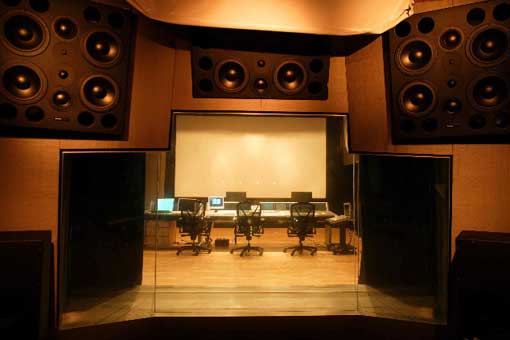
Rahman’s recording and mixing
Not just Rahman, about all music composers use loops or samples which they buy from distributors like Sony or Apple. Its like instead of calling a performer like a guitarist to perform for his/her song a composer buys his recorded piece and uses it. These pieces are royalty free its like the guitarist sells it to Sony on an agreement and Sony distributes it through out the world. That is why you find same sound effects in two different songs of Rahman some times. Loops are not necessary to be only a single note. It can be chords or even a piece or a scratch.
How many of you have noticed this in Rahman songs especially those who are musicians. All his songs irrespective of the mood has a constant ‘pads’ or ’strings’ backing. The chords played with the pads and strings is also not conventional. They are the 7ths, 11ths or Diminished chords. They give the song a ‘feeling’, a ’soul’. Quite Technical
A classic example is the song “Thirupachi Arivalaa” from Taj Mahal. Check out the pads in the songs. Another is “Aye Udi Udi” from Saathiya. Remove the pads these songs become soul-less and very plain.
The only other person who uses this same method is Harris Jayaraj. And for sure he learned it from Rahman .Wonder if more music directors should do the same.
A R Rahman started learning Indian classical and Carnatic classical in 1992. Since almost all his songs are Raga based just wanted to clarify that he learned classical before or after 1992.
How does he compose a new tune. Does he play it in his piano or does he write the swaram or how does he go about conceiving a song out of nowhere and create a master piece.
Its a fact that no softwares in the world can create a tune. The people who learned music will laugh their stomachs out if someone tells them that Tere Bina or any song is a product of a software. Now what can a software do. What does Rahman do in his studio with all those softwares. Why does he always updates his software. It is very simple. Just a brief concept.
1. Rahman records a songs over a period of 10-15 days. A singer sings one song perhaps innumerable time till Rahman gives a hands up. Once that signal has been got the singer realizes that his job is done . Now Rahman sits over his singing and edits the bad parts and couples all the best parts and after another day of hard work the singers work is ready. The singer never sang that song continuously but his best parts are selected and sampled .
2. Rahman then records music or what you call as BGM. After that he mixes it with the vocal part. Then suddenly he may realize that both of them don’t gel well in frequency. And then frequency division modulation takes place. Its a huge process friends which very well packs the music and vocal part.
3. Let us take an example of Shreya Ghosal. Rahman needs Shreya Ghosal to sing in track 15 ie the Highest. But Shreya can sing only till 11. So what can Rahman do. Let her sing in track 8 -9 in which she is comfortable and then simply phase modulates the vocal to appear as if she sang in track 15. This is a very costly process and risky too so Rahman has done it only 5-6 times.
So A R Rahman is a genius , not a technician. He uses softwares but doesn’t use to “produce” tunes. Instead he use them so effectively to “edit” tunes. And that is why perhaps he is the best. He uses Technology but his originality is maintained in each song.
A software has no brains. It will do what you tell it to do. So if anyone program his software to sing “Sa Re Ga Ma Pa” then yes, you are right. Software can produce tunes. And everyone is pretty sure Rahman uses custom made softwares. The bottom line is Softwares Do Not Produce Tunes.
What do u mean by a Track ?
Many people have different definitions of tracks . “Track” is not a musical keyword but it pretty software related. We divide a tune into several sound parts. Every channel has a baud rate frequency. For example if you hum a voice in a low scale u may call it as a track 1. The song “Jaage Hain” goes very high enough to be called as track 15 . Empirically track is a pitch depth value versus volume. The intersection of the graph is the resonant value. This value is what the purest and the “Virgin tune” we call. It is difficult to acheive this reasonable value due to several reasons but Rahmans studio is feature adapted to it. Almost 99% of his songs are reasonabaly valued .
We heard a lot of spectra sonics stuff in Rang de Basanti. Especially the amazing pads from spectra sonics atmosphere. He’s also been using swarplug, an Indian instrument plug in, which can be heard in water and the background score of RDB. The santoor you hear in “Chanchan” from Water is actually swar plug doing the job.
Its easy to use software but it ain’t easy to create stuff with software. Samples are an easy way out and most music directors are going the samples way because its easier and quicker.
This includes people like Salim Sulaiman sadly, they lack tunes. Himesh, lacks creativity and singers, Shankar Ehsaan Loy , these three guys are actually pretty good, Sandeep Chowta. He’s not even a music director according to criticism, more a DJ kinda fellow.
Someone like Rahman, takes the pain of creating his own samples as well apart from using purchased ones. Now thats a huge difference. This combined with the responsibility of making path breaking tunes is a big big task. Make no mistake about it.
What thus we say can be summed up thus give the same equipments, computers, keyboards, the musicians, the software, the samples etc. To any other music director in the country they still cannot match A R Rahman it takes a genius to create something extraordinary like he does.
Being the user of these sound editing softwares we can give us suggestions. The usage of sound editing softwares such as Neundo, Cubase ,Sonar and Logic is very helpful and reduces our work in the technician point of view. Though these sounds are pleasant and filling they spoil the naturalizing of the song. But Rahman’ comprehension on the editing softwares and plugins and using them in his songs and BGM is fantastic. But that in itself is his drawback. A R Rahman has one of the largest collections of samples in Asia.
Music Director vs Music Composer
“Music director” is not really a Music Composer. He is basically the guy who makes the tunes for the songs. Then he gives it to the lyricist for the lyrics. This works vice versa too. Lyrics first and then the tune. Now comes the major difference between “Music directors” and “Music Composers” like A R Rahman and Ilaiyaraaja.
The Music Director hands over the tune and lyrics to the Music Arranger who will fill in the music into the song according to his knowledge and experience. The Music Director will only direct the music as in supervising the process but does not necessarily compose the BGMs, the rhythms, the chords, bass lines etc. in the song. These are done by the Music Arranger, who will arrange for the violin sections, the brass sections, the percussions, the beats etc. according to what he knows.
Needless to say, the Music Director, more often than not, is not even proficient in playing a musical instrument. He need not be with the method mentioned above.
This is why most Music Directors sound the same movie after movie after movie. Because the tunes are different but the arrangement is the same. The Music Arranger guy is only doing his job and ending the works as per deadline. No creativity there. There is no effort to innovate.
A R Rahman though, it seems, sits and works on each piece of music in his songs. Each sound and each element of the notes are heard by him, evaluated and then entered into the song. Plus he has great musicians to bring out quality sounds.
In other words, Rahman actually designs the sound for each of his songs. To all those who scoff at use of technology in music this sound design is enhanced only because of the technology.
This sound design combined with great tunes make great masterpieces. Any surprise his songs are so good ?
A R Rahman ~ His Professionalism
1. A R Rahman is perhaps the most professional musician of India. He has this habit of looking out for talented musicians and then he calls them to his studio and records and samples their stuff. And then the musician packs his bags and is off to where he/she belongs. The best part comes now, whenever Rahman will use that sample/loop in any of his songs, he makes a point that he pays that musician his royalty !! Isn’t this wonderful ?
2. One of the musicians has played the Dholak in “Taal Se Taal Mila” and here’s the story. When the musician went to Rahman’s studio for recording the Dholak he was all set as he found the rhythm not that challenging. But the real fun came now. Rahman asked him to wear Ice cream sticks tied with rubber-bands to his finger (the Chati i.e. side which produces the high pitch sound). This was indeed unique as Rahman was pretty clear on what “sound” he wanted.
Thats A R Rahman for you. The best musician India has produced after R D Burman.
Something About Music Sampling For Starters
In music, sampling is the act of taking a portion, or sample, of one sound recording and reusing it as an instrument or element of a new recording. This is typically done with a sampler, which can be a piece of hardware or a computer program on a digital computer. Sampling is also possible with tape loops or with vinyl records on a phonograph.
Often “samples” consist of one part of a song, such as a break, used in another, for instance the use of the drum introduction from Led Zeppelin’s “When the Levee Breaks” in songs by the Beastie Boys, Dr. Dre, Eminem, Mike Oldfield and Erasure, and the guitar riffs from Foreigner’s “Hot Blooded” and Tone-Loc’s “Funky Cold Medina”. Samples in this sense occur often in hip hop, as hip hop sampling developed from DJs repeating the breaks from songs and Contemporary R&B, but are becoming more common in other music as well, such as by Slipknot’s sample player Craig Jones.
Early Cases
Sampling using tape recordings goes back at least as far as 1969, when Holger Czukay used traditional Vietnamese singers on his record “Canaxis”. Czukay and his former band used samples often throughout the seventies.
One of the first major legal cases regarding sampling was with “Pump Up the Volume”. As the record reached the UK top ten, producers Stock Aitken Waterman obtained an injunction against the record due to the unauthorized use of a sample from their hit single “Roadblock”. The dispute was settled out of court, with the injunction being lifted in return for an undertaking that overseas releases would not contain the “Roadblock” sample, and the disc went on to top the UK singles chart. Ironically, the sample in question had been so distorted as to be virtually unrecognizable, and Saw didn’t realize their record had been used until they heard co-producer Dave Dorrell mention it in a radio interview.
Types of samples
Once recorded, samples can be edited, played back, or looped i.e. played back continuously. Types of samples include:
Some facts about A R Rahman
1. A R Rahman records most of the songs in the late night because he belives that is the time at which a person’s sound will be at it’s top best.
2. Rahman allows singers to sing there own versions of the song separately and chooses best among them.
3. There are more than 1000 samples available in Sony and Apple.
4. Rahman has used a ghatam loop in the Rang de Basanti background score from Apple’s loop library. The same loop been used elsewhere. But it sounded a lot better the way Rahman used it.
5. The song “Maiyya Maiyya” has a flute interlude in the beginning similar to the one in Anu Malik’s “San Sanana” song in Asoka. The flute sample in Mayya Mayya is a commercially available sample. Both the Asoka song and Mayya Mayya have been arranged and programmed by Ranjit Barot.
6. Chinna Chinna Asai was composed as a ’sad’ full song initially but later was changed to a happy song.
7. ARR first composed only the first stanza of “Tu hi Re” song for Bombay. Later Mani Ratnam shot the song and after feeling confident of the song, Rahman completed the composition.
8. Thiruda Thiruda and Duet took most time in composing followed by Box-office Flop Mangal Pandey.
9. Maiyya Maiyya was recorded in Toronto and music was added later as usual.
10. In Thiruda thiruda there are two special songs in it. One is Konchum Nilavu which is fully computer programmed. Another is Rasathi where you can’t hear a single instrument.
No matter how intensively A R Rahman uses technology, but we are always astonished how he stands unique with same softwares. Its all creativity Guys. Always wonder how he pours soul in music and creates a situation through music, a world in which we are lost.
A R Rahman is a great Sound Engineer of all the times. There are certain frequencies which sooth our brain, may be A R Rahman know which frequency level or modulation will leave soothing impact on listener’s brain. Its possible and we can achieve such frequency levels through softwares.

 I was inspired to write this article about 'Kadalai' by someones thought of an Ideal date, which was 'A lousy walk on the shore by the moonlight having kadalai and putting kadalai (Tamil slang for light hearted romance) with someone very dear.' Wow!! How could I possibly not think of this before... Somethings like these makes one realise what a wonderful language Tamil is...seriously I cannot think of any other language as effective as Tamil is...